
OCT Scan
See more than a standard eye examination can reveal
At Whitehouse & Son Optical, we use advanced OCT eye scanning to look beneath the surface of the retina and examine the detailed structures at the back of your eye.
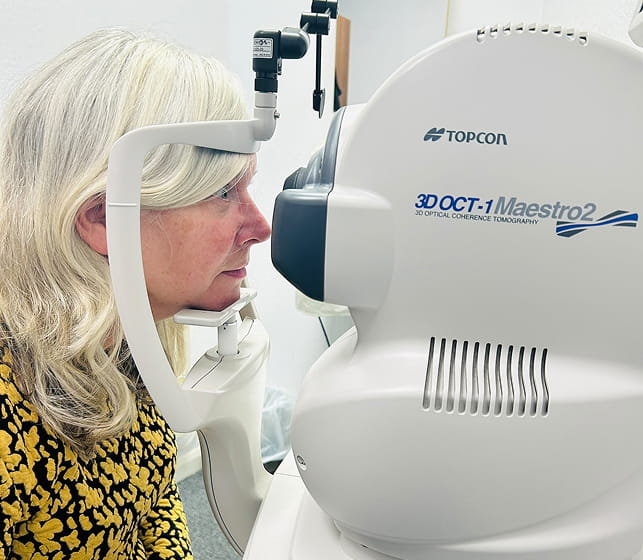
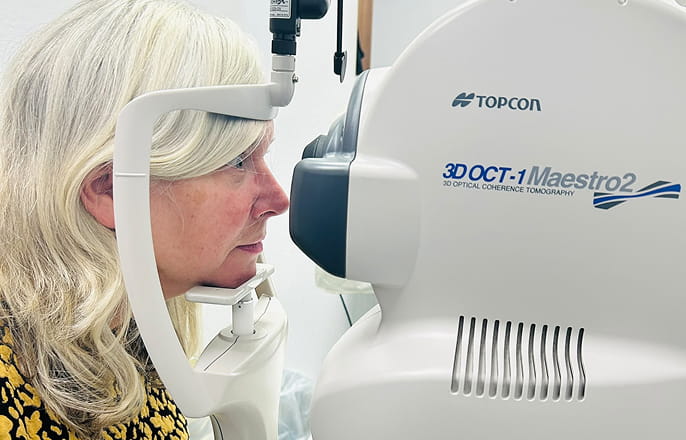
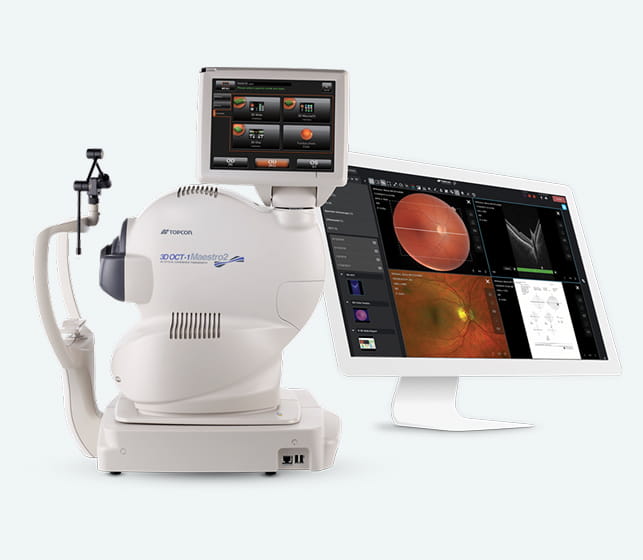
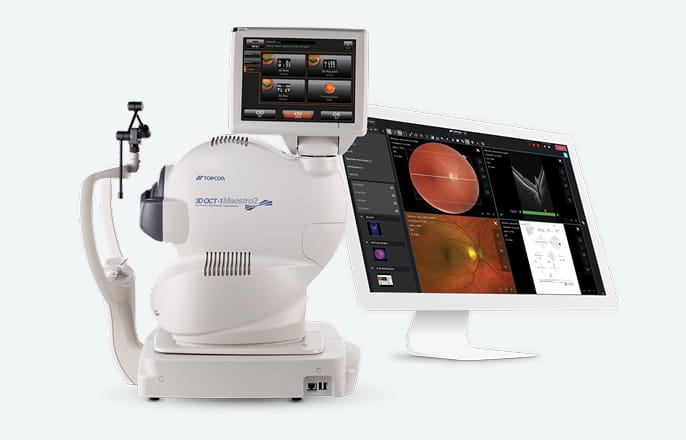
Our Topcon Maestro OCT produces high-resolution, cross-sectional images of the retinal layers and optic nerve. This can help identify subtle structural changes that may not be visible during a standard eye examination alone.
The scan is quick, comfortable and non-invasive, taking around two minutes on average. It can also provide valuable information for monitoring your eye health over time.
Request an OCT eye scan at Whitehouse & Son Optical and take a closer look at your eye health.
Have an Enquiry?
Please complete the form below and a member of our team will be in touch.
What is an OCT eye scan?
OCT stands for Optical Coherence Tomography. It is an advanced imaging technology that uses light to create detailed images of the structures inside your eye.
A conventional retinal examination provides a view of the visible surface of the retina. OCT goes further by producing cross-sectional images of the individual retinal layers, allowing your optician to see structural detail beneath the surface.
This can help identify changes such as retinal thinning, swelling or fluid and provide measurable information that can be compared during future examinations.
Our Topcon Maestro OCT scanner
We use the Topcon Maestro OCT system, combining detailed imaging with automated operation to make the scanning process straightforward and comfortable.
The scanner can automatically align, focus and capture the required images. This reduces the need for manual adjustments and can be particularly helpful for patients who find it difficult to keep completely still.
Key benefits include:
- Scans take around two minutes on average
- Detailed imaging of the retina and optic nerve
- Automated alignment and focusing
- Non-invasive, contact-free scanning
- Radiation-free imaging
- High-resolution images that can be explained to you
- Measurements that can be compared over time
This gives you access to advanced retinal imaging in a comfortable local setting.
Why is OCT useful?
A standard eye examination remains essential for assessing your vision and eye health. However, some changes occur within the retinal layers and optic nerve before they become obvious during a conventional examination or cause noticeable symptoms.
OCT provides another level of information by allowing us to examine these structures in much greater detail.
It can help identify and monitor changes associated with conditions including:
Glaucoma
Glaucoma can damage the optic nerve and cause progressive loss of vision. OCT can measure the thickness of the retinal nerve fibre layer and help identify structural changes that may be associated with glaucoma.
These measurements can also provide a useful baseline for future monitoring.
Age-related macular degeneration
OCT can reveal changes in the macula, including fluid and other structural changes associated with age-related macular degeneration.
Detailed imaging can help your optician monitor the macula over time and identify when further assessment may be appropriate.
Diabetic eye disease
Diabetes can affect the blood vessels supplying the retina. OCT can help identify retinal changes, including swelling associated with diabetic macular oedema.
If your results suggest that further investigation is needed, your optician will explain the appropriate next steps.
OCT and early detection
One of the key benefits of OCT is its ability to reveal subtle structural changes that may occur before you notice changes in your vision.
This can be particularly useful when monitoring conditions that develop gradually. Having detailed images of the retinal layers and optic nerve gives your optician additional information alongside your symptoms, clinical examination and other tests.
OCT does not diagnose every eye condition, and an unusual scan does not necessarily mean that you have an eye disease. The images must always be interpreted by a qualified eye care professional in the context of your overall eye health.
If we identify a change that requires further investigation, we will explain what we have found and recommend the appropriate next step.


Monitoring your eyes over time
OCT is valuable not only for identifying changes but also for monitoring them.
The scan provides measurable information about structures such as the retina and optic nerve. Images and measurements can be compared with previous scans, helping your optician identify changes over time.
This can be particularly useful when monitoring conditions such as glaucoma, macular degeneration and diabetic eye disease.
Having a baseline scan can also provide a useful reference for future examinations.
Supporting referrals and ongoing care
If an eye examination or OCT scan identifies a potentially significant change, the additional structural information can help your optician make a more informed clinical assessment.
Where appropriate, this may support a referral to an ophthalmologist or another eye care professional for further investigation or treatment.
OCT is not a replacement for a comprehensive eye examination or specialist assessment. It is an additional diagnostic tool that can provide valuable information to support your ongoing eye care.




See your eye health in detail
OCT produces high-resolution images that we can show and explain to you.
This means you do not simply have to rely on a description of what your optician has found. We can use the images to help you understand your eye health and discuss any changes or recommendations.
We believe clear communication is an important part of good eye care. If you have questions about your scan, we will take the time to explain the results in straightforward language.
Is an OCT scan safe?
Yes. OCT is a non-invasive imaging technique that uses light rather than ionising radiation.
The scan does not require contact with your eye and is generally quick and comfortable. Because it does not use ionising radiation, OCT can be used repeatedly when clinically appropriate to monitor changes over time.
Your optician will explain the process before the scan and make sure you are comfortable throughout.
What happens during an OCT scan?
An OCT scan is simple and usually takes around two minutes.
1. You sit comfortably at the scanner
Your optician positions you in front of the Topcon Maestro and explains what you need to do.
2. You look at a target
You will be asked to look at a small target while the scanner captures images. The automated system helps align and focus the device.
3. The images are captured
The scanner captures detailed images of your retina and optic nerve without touching your eye.
4. Your optician reviews the results
The images are assessed alongside your wider eye examination and any relevant symptoms or medical history.
5. We explain the findings
How is OCT different from a standard eye examination?
A standard eye examination assesses your vision, prescription and general eye health using a range of clinical tests.
OCT adds detailed structural imaging of the retina and optic nerve.
Standard eye examination
- Assesses vision and prescription
- Examines the health of the eyes
- Includes a range of clinical tests
- Helps identify signs of eye disease
- Results are assessed during each visit
OCT eye scan
- Produces cross-sectional retinal images
- Shows detailed retinal and optic nerve structures
- Provides measurable structural information
- Can reveal subtle structural changes
- Images can be compared over time
Who may benefit from an OCT scan?
OCT can be particularly useful for patients who need a more detailed assessment or ongoing monitoring of their eye health.
It may be recommended if you:
- Have a family history of glaucoma or other eye conditions
- Have glaucoma or are being monitored for it
- Have age-related changes affecting the macula
- Have diabetes
- Have noticed changes in your vision
- Have a known retinal or optic nerve condition
- Need ongoing monitoring of an existing eye condition
Your optician will advise whether OCT is appropriate based on your individual circumstances.
Frequently Asked Questions
How long does an OCT scan take?
An OCT scan takes around two minutes on average. The Topcon Maestro automatically aligns and focuses to capture the required images.
Does an OCT scan hurt?
No. OCT is non-invasive and does not require the scanner to touch your eye. Most patients find the process quick and comfortable.
Does OCT use radiation?
Can OCT detect glaucoma?
OCT can identify and measure structural changes associated with glaucoma, including changes to the retinal nerve fibre layer. It provides valuable information alongside other clinical tests used to assess and monitor glaucoma.
Can OCT detect macular degeneration?
OCT can show structural changes in the macula, including fluid and other changes associated with age-related macular degeneration. Your optician will interpret the findings alongside your wider examination.
Can OCT detect diabetic eye disease?
OCT can identify retinal changes such as swelling associated with diabetic macular oedema. Further assessment or referral may be recommended if your results indicate a potential problem.
Can OCT find problems before I notice symptoms?
OCT can reveal subtle structural changes that may occur before noticeable changes in vision. However, it is one part of a wider eye health assessment and cannot detect every eye condition.
Do I need an OCT scan at every eye examination?
Not necessarily. The frequency of OCT scans depends on your individual circumstances, eye health and clinical requirements. Your optician will advise you on the most appropriate approach.
Can I see my OCT results?
Yes. We can show you the high-resolution images and explain what they mean in clear, straightforward language.
Is OCT the same as an eye examination?
Request an OCT eye scan
An OCT scan gives your optician a detailed view of the retina and optic nerve, helping identify and monitor structural changes that may not be visible during a standard eye examination alone.
At Whitehouse & Son Optical, our Topcon Maestro OCT provides advanced retinal imaging in a comfortable local setting, combined with the time and personal attention needed to understand your results.
Contact Whitehouse & Son Optical to arrange an eye examination with OCT scanning and take a closer look at your eye health.